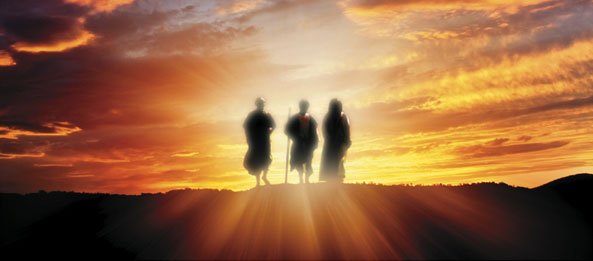
“I’m gutted. How could we get it so wrong? I really thought Jesus was the one. I mean he had the power; we saw his miracles before our eyes! And his teaching; phew! We’ve heard good rabbis but no one ever spoke like him. I really thought he was the one the scriptures spoke about; I thought he was the Messiah. That’s what I told my family. Now it’s all over, like a dream. When I awoke this morning I had to face it; Jesus is gone!” As Cleopas spoke he heard steps behind and turned. A stranger had caught up with them. “You two look serious, what are you talking about?” he asked. For a moment Cleopas thought the voice was familiar, but he could not place it. But this was good; three would be safer than two on the road to Emmaus. “It’s about the things that have been going on in Jerusalem,” said Cleopas. “What things?” asked the stranger. “Jesus who was crucified,” replied Cleopas looking surprised, “You must be the only one who doesn’t know!”
Luke 24:13-49 explains that the inquisitive stranger was Jesus. Cleopas and his friend had an interesting day with him. I would like to comment on some of the things that were said and done on this thought provoking day. If you are not familiar with the story it will help to read the verses above first.
Cleopas claimed Jesus was a prophet, but he had hoped Jesus was the Messiah. He had come to a logical conclusion; if Jesus was dead he could not deliver Israel and could not be the son of David who would rule forever. The best Jesus could be is a prophet like Elijah or Ezekiel. But he didn’t know that Jesus had risen from the dead and was the stranger walking beside him. Once Cleopas realised that Jesus had overcome death, he returned to the belief that he was the Messiah; the one who would rule forever. Muslims should take note of Cleopas’ thinking here, because the Quran agrees that Jesus is the Messiah or Christ (Surah 4:171) but it does not say what the title means. But right through Judo-Christian scripture the Messiah is always more than a prophet or messenger. He is the King who would rule forever, and that is what Jesus himself claimed; that he was King of a heavenly kingdom (John 18:36). Equally Christians need to realize that Christ’s Resurrection is their central message. It’s the message that makes all the difference. If Jesus did not rise from the dead, there is no gospel (good news). Paul put it like this, “If Christ has not been raised, your faith is futile; you are still in your sins…But Christ has indeed been raised from the dead…” (1 Corinthians 15:14-20).
But notice how the disguised Jesus responds to Cleopas’ suggestion that he is just a dead prophet. He says, “How foolish you are, and how slow to believe all that the prophets have spoken! Did not the Messiah have to suffer these things and then enter his glory?” Jesus then goes into a lengthy survey of what Moses and the Prophets said showing how the Messiah was to die and rise again. There is a lot of material Jesus could have used for this including the Passover, temple sacrifices, and the promises made to David. But my favourite is the account of Abraham going to sacrificing his son and receiving him back alive. This is powerful picture of Christ laying down his life as a sacrifice for sin and returning from the dead to start a covenant nation (See Isaacs Easter).
Clearly Cleopas and his friend enjoyed Jesus’ explanation as to why he was more than a prophet because they later said, “Were not our hearts burning within us while he talked with us on the road ..?” This meant his teaching filled them with a faith and a passion that burnt within. I have felt that on occasions when listening to a preacher who has fresh revelation that seems to make sense of all the unknowns. That’s what Jesus was doing.
At meal time their eyes were opened. They saw that the stranger was Jesus. Scripture specifically says that they were kept from seeing it was Jesus until the right moment (16). Perhaps God intercepted their memories, so they could see but not recognize him. Then when the stranger broke bread they suddenly saw who it was, and then Jesus disappeared from their site. Can you picture Cleopas staring at the empty seat with a piece of bread halfway to his mouth? There’s a lesson in this. Revelation of Jesus is a sovereign act of God. We cannot make it happen.
Cleopas and his friend returned. They were leaving Jerusalem; everything had come to a bitter end. Now they had a reason to return. The show was not over; Jesus had risen from the dead. This was just beginning! They were super excited and couldn’t wait to share the news with the other disciples. Has this happen to you? Did Jesus change the direction your life was going in? Did he fill you with a passion to talk to others about him? It happened to me.
Jesus shows he is flesh and bones. As Cleopas is telling the eleven about their experience on the Emmaus road, Jesus appears in the room among them. For Cleopas and his friend this was the second appearance in two days. You might think they would be comfortable with it, but they weren’t. They were gripped with fear thinking Jesus was a ghost! So Jesus does what he can to show them that he is physical. He shows them his scars, he allows them to touch him, and he demonstrates how he can still eat by having a meal in front of them. Even today Christians do not fully grasp the fact that the resurrection is physical. We talk as if resurrection is all about leaving our bodies and going to heaven. No, it’s being reunited with our bodies and using them on earth. That’s right! The last two chapters of the Bible tell us there will be a new heaven and a new earth. Our resurrected bodies are designed for the earth! Oh, it’s true that we go to heaven, but later heaven comes to earth. Somehow the church has forgotten this.
If Jesus’ resurrection was just a spiritual rising of the soul his body would still be in the tomb and Christians would have no way to prove he was any different to any other good believer. But the resurrection was bodily and physical and those who are witnesses experienced Jesus that way; they took his bread, they touched his scars, they enjoyed his breakfast (John 21:12). And as Jesus did these things he was saying ‘Follow me’ (21:19), he was showing us the way; his resurrection is proof that ours will follow. “Happy Easter!”
Genesis 6:11-17, 7:21-8:1, 9:1-11 Death & Resurrection in the Ark and Cross
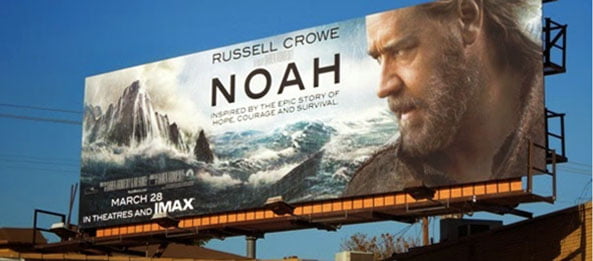
The new NOAH film starring Russell Crowe has come at a good time. Although it doesn’t represent the Bible account very well, it is at least a reminder of the basic story and Noah’s story is full of things we should be thinking about at Easter. Oh, some may say, what could the flood story have in common with Easter? Quite a lot actually, but especially the idea of death and resurrection. In the flood story we see how sin is judged so a new creation can follow; and these are the main elements we see in the cross of Christ. In fact the author of Genesis composed the flood story in what is known as a ‘chiasm’ (a cross X pattern) to emphasize God’s judgement of the old creation and his raising up of a new one. You can see the left half of the X pattern below (a complete X would look like an hour-glass). The verse ‘God remembers Noah’ is at the centre of the X and it separates verses on the coming flood (or judgement) from verses on the subsequent new life (or resurrection). Verses above have a sort of mirror affect on verses below. For example 7 days waiting for the flood (judgement) is mirrored with 7 days waiting for the water to subside (resurrection).

Although the chiasm (cross pattern) highlights death and resurrection there are a number of other interesting parallels between the salvation of Noah’s ark and the salvation of Christ’s cross.
1. Both Noah and Christ are a kind of Adam. Noah is the second Adam while Christ is the last Adam (1 Co 15:45). Noah is the second Adam in the sense that he is in charge of the new earth after the flood just as Adam was in charge of the new earth at the beginning. Christ is the last Adam in the sense that he is in charge of new creation after the cross; this new creation starts with believers receiving newly created hearts and is completed when there is a new heaven and earth.
2. Both the ark and Christ are life vessels. Just as those in the ark were saved while those outside perished, so those in Christ are saved, while those outside perish. And because Christ is the last Adam, he is the last life boat. If we miss his salvation there is no other.
3. Both Noah and Christ head up a covenant between heaven and earth. With Noah God vows to never destroy the earth by water again, with Christ God vows a creation that will never perish.
4. Both the saved in Noah’s ark and the saved in Christ are commissioned. Noah and his family are told to ‘Be fruitful and increase in number and fill the earth’ (like Adam was told). Christ’s disciples are told to ‘Go make disciples of all nations,’ which is another way of populating the earth with people saved by God.
5. Both accounts have a future kingdom promised and both have tastes of that future kingdom breaking into the present. With Noah the dove brings an olive leaf from the promised-land and with Christ the Holy Spirit brings the power of the future kingdom in the form of healings and miracles.
So there are some striking similarities between the salvation of Noah’s ark and the salvation of Christ’s cross. But the main one is death and new life, and this is the story of Easter.
Now we may ask why there is a parallel between the salvation of Noah and the salvation of Christ. The Bible calls such a phenomenon a fore-shadow or ‘a shadow of things to come’ (Col 2:17). Noah’s ark is a fore-shadow of Christ’s cross. A shadow is made by an object. It has the same basic shape as the object but it is not the object. If a shadow precedes a moving object it tells you the object itself is about to arrive. Noah’s salvation had the same basic shape as Christ’s and God used it to warn people that the real salvation in Christ was about to arrive. Once it arrived it could be recognized because Noah’s salvation which had already come had the same shape.
Now think of the magnitude of all this. The account of Noah’s flood was composed hundreds of years before Christ and yet it stands like a massive billboard (see our picture above) announcing his salvation. This is huge, and we believers ought to get with the program. If God was shouting ‘salvation’ so long ago, we should be shouting it too. We dare not be silent. So here’s an idea. Why not use the publicity surrounding the new Noah movie for Jesus Christ? Instead of focusing on what was wrong with the movie why not show people how the salvation of Christ was foretold in Noah’s story so long ago. The cross has said it all, but the ark is a shadow of it. May your days following Easter impact your community for Jesus Christ.
“Today this scripture is fulfilled in your hearing” (Luke 4:21)
Hebrews 3:7-4:11
“You often ask about our church Josh, why not come with this Sunday?” George inquired. “Yes, join us Josh!” said Eric. Josh smiled, “I can’t guys; I do the Sunday shift.” “Oh, that’s right,” mumbled George. Eric seemed lost in thought for a moment then looked up, “I tell you what Josh, I’ll do your shift this Sunday, and you go with George, how’s that?” George looked at Eric with shock, “Eric! You know what we believe. We don’t work on Sundays. It’s our Sabbath!” Eric’s stared back, “George! Which is right on the Sabbath: to help or to hinder, to give or withhold?”(Mark 3: 4) George remained silent. But Josh looked pleased, “Thanks Eric, I accept your offer… so Sundays your Sabbath is it? That’s odd. We Jews have ours on Saturdays; I wonder why it’s different?” George and Eric looked at each other blankly. “I haven’t a clue,” said George.
Hebrews 3:7-4.11 is about God’s Rest. It was written to Jewish believers who were used to observing the Sabbath and it gives us some insight into what the early church believed about it. The writer of Hebrews was trying to persuade these believers not to turn back to Judaism even though they were under pressure to do so. He tells them not to be like their forefathers who turned back when God had called them to enter the Promised Land. He continually refers to Psalm 95.7-11 which says, “Today, if you hear his voice do not harden your hearts as you did in the rebellion, during the time of testing in the desert, where your fathers tested and tried me…I declared on oath in my anger, ‘They shall never enter my rest.’”
In speaking of God’s Rest, the writer assumes that the rest found in the Promised Land and the rest experienced on the seventh day are the same thing (4.4). He sees both as sign posts pointing to a greater rest that neither Moses (who received the Sabbath law) nor Joshua (who entered the Promised Land) fully understood (4.8). This greater rest is the rest that is found in Christ.
The writer focuses on the word ‘Today.’ He says, “God again set a certain day, calling it Today…Today, if you hear his voice, do not harden your hearts” (4.7), “Encourage one another [to enter] daily as long as it is called Today” (3.13). His point is that God’s rest can be entered today and every day, that God’s rest is like a land or country that is continually available to anyone who believes. This concept will sound familiar to many Christians; we usually call this divine land the ‘Kingdom of God’. Anyone who enters God’s kingdom enters his rest; or his ‘Sabbath.’ So the New Testament Sabbath is not a sacred day, it is a sacred kingdom. We enter the kingdom and the kingdom enters us. It is God’s rule breaking in and bringing order to our lives and to all we minister to. This is what Jesus modelled. When Jesus healed and helped people on the Sabbath he was accused of working on a sacred day, just like our friend Eric above. But Jesus did these things on the Sabbath because he knew that the sacred day was just a sign post pointing to God’s sacred kingdom; a kingdom that brought salvation, healing, and wholeness to a lost world.
Another aspect of the Sabbath that points to God’s kingdom is the Year of Jubilee. In Israel every seventh year was considered a Sabbath Year when fields were left to ‘rest’ – they were not allowed to be cultivated. Every 49th year (7X7=49) was a Sabbath of Sabbath’s called the Year of Jubilee. At this time all Jews who had been sold into slavery were set free and all tribal lands were returned to their original owners. Many Israelites waited much of their lifetime for the Year of Jubilee, and so it was welcomed in with great rejoicing. If the Sabbath was a sign post pointing to God’s kingdom, the Year of Jubilee was a billboard that shouted it across the nation! Jesus said in Luke 4.16-21, “The Spirit of the Lord is on me, because he has anointed me to preach good news to the poor. He has sent me to proclaim freedom for the prisoners and recovery of sight for the blind, to release the oppressed, to proclaim the year of the Lord’s favour (the Year of Jubilee).” Here Jesus was announcing the fact that he was about to activate an everlasting Jubilee. The kingdom of God is this Jubilee; it is the Sabbath of Sabbaths. As we embrace God’s kingdom we are set free from spiritual slavery and debt, and are raised up to rule with Christ.
The word Sabbath originally comes from the Hebrew verb ‘sabat’ meaning to ‘cease’ or ‘rest’ from work. Genesis 2.2-3 says, “By the seventh day God had finished the work he had been doing; so on the seventh day he rested (sabat) from all his work. And God blessed the seventh day and made it holy, because on it he rested (sabat) from all the work of creating that he had done.” The concept of God resting seems strange to us today. Does God get tired? Did he rest on the eighth day too? The reason we sometimes ask these questions is because we lack the cultural context in which it was written. In ancient times people were always building temples for their gods. When they had completed the building, they ‘ceased’ their work and invited their god to ‘rest’ in it. When they invited their god to rest they brought the image of the god (the idol) to ‘rest’ there too. The idea was that the god would make itself at home in the temple and ruled from it. So on top of the idea of ceasing from building was the idea of resting in position. Rest did not imply relaxation, it implied occupation; it implied being enthroned as the ruler. Any ancient person reading the Genesis creation story would immediately recognize a six day process in which a temple was being built for Israel’s God. They would understand that there were six days of building followed by a seventh when Israel’s God came to rest in the temple. What would have been different and quite mind blowing for any ancient reader is the fact that the temple was ‘heaven and earth’ and that Israel’s God built it himself! This was the great claim of Israel; their God was the only true God and there was no place for any others. There were no sky gods, earth gods or moon gods. The universe belonged to the God of Abraham, Isaac, and Jacob; it was his temple! This is why the Sabbath was so important to God and the people of Israel; it was a massive declaration to all other nations. The number seven symbolised completion; the God of Israel ceased and rested when heaven and earth were set up and ready to function. It was a bit like an office being set up so that the director could take control. Something similar happened when Jesus breathed his last breath on the cross, he said, “It is finished,” which means it is over, the work is done, the kingdom of God can now begin to occupy the earth. The work of the cross ceased so that God’s rule and rest could begin.
The idea of God’s rule invading the earth adds another important aspect to God’s rest. Entering the Promised Land required action, it required a fight. Israel had to take on the enemy, the ‘giants’ in the land in order to enter. And this is what Jesus was doing as long as he was delivering and healing on the Sabbath. He was destroying the works of the enemy and cementing the order of God’s kingdom. So we see that God’s rest is not to be thought of as something passive, in the sense of a day off, it is about being active for the kingdom of God. When Jesus was criticized for healing on the Sabbath he said, “My Father is always at his work to this very day, and I too am working” (Jn 5,17).
Recognition that the Sabbath day was just a sign post or a shadow of Christ’s kingdom had an early place in Christian thinking. In Paul’s letter to the Colossians he said, “Do not let anyone judge you by what you eat or drink, or with regard to a religious festival, a New Moon celebration or a Sabbath day. These are a shadow of the things that were to come; the reality, however, is found in Christ” (Col 2.16-17). Evidently some Jewish believers had been pressurizing the Colossian Gentiles to start observing laws like Sabbath days and Paul was saying ‘no, you don’t have to, Sabbath days are just shadows of the God’s real rest that is found in Christ.’
As indicated by our opening conversation, there is often confusion as to why churches meet on the first day of the week (a Sunday) instead of the seventh day (a Saturday). Didn’t God rest on the seventh day? Wasn’t the seventh day the original Sabbath? Well yes, but the early church never considered a Sunday to be a Sabbath; they met on Sundays because that was the day Jesus rose from the dead. They called it the ‘Lord’s Day’ not the Sabbath (Rev 1.10). For them the Sabbath was fulfilled in Christ; the Rest of God was a sacred kingdom and not a sacred day. Some Jewish believers did continue to observe the Sabbath day for a while (Ro 14.5-6), it was a habit that was hard to break just as the issue of clean and unclean food was, and Paul allowed for the effect it might have on their consciences. But Paul did this a concession for those whose ‘faith is weak’ (Ro 14.1) and was greatly disappointed when he discovered that some of the Gentile believers were doing the same thing saying, “You are observing special days and months and seasons and years! I fear for you, that somehow I have wasted my efforts on you” (Gal 4.10).
So what does it mean to keep the Sabbath today? Well, it starts by us entering God’s kingdom and allowing God’s kingdom to enter us. This is the true Rest of God. We do this by faith. The writer said, “Today, if you hear his voice, do not harden your hearts.” This is not just about being ‘born again,’ it is that and more. It’s about acting for God’s kingdom in an ongoing way. Jesus is our example; we act for the kingdom like he did. This means ‘ceasing’ from doing things in our strength and ‘resting’ (occupying and ruling) in God’s strength. It means praying, “Your kingdom come, your will be done on earth as it is in heaven,” and then going out and acting on it. It means bringing salvation, deliverance and healing to all creation. It is a faith that is active, not a day that is passive.
Hebrews 12: 1-2
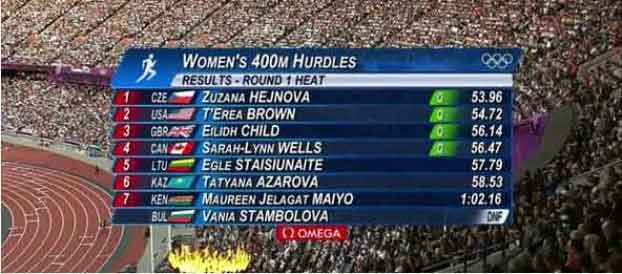
Above are the results for the first heat of the women’s 400m hurdles at the recent Olympics. This photo became a hit on Facebook due to the last name on the list. Vania Stambolova had stumbled over the first hurdle and did not finish. Today we are discussing the spiritual race we are in and how we can make sure we don’t ‘Stambolova!’
The writer of Hebrews likens our spiritual journey to an Olympic race. He says “Since we are surrounded by such a great cloud of witnesses, let us throw off everything that hinders and the sin that so easily entangles. And let us run with perseverance the race marked out for us.” The Olympics was well known in New Testament times. It was invented by the ancient Greeks and continued under the Romans. To fully grasp what the writer is saying when he says “Throw off everything that hinders and … entangles,” we need to understand how Olympic runners ran in ancient times. In those days they ran completely naked; that’s right, no clothes at all! They had not developed the synthetic body-hugging gear that athletes wear today, and their normal clothing was loose fitting robes and skirts that were liable entangle the runner as he ran. So the runner ran naked. Outright nakedness is what the writer has in mind, and it is what his readers would have understood. So he is telling us to run our spiritual race completely naked of all sin; ‘the sin that so easily entangles.’ This is powerful. We think a little sin is ok, but he is saying it will slow you. So let’s get personal. Is sin entangling you? What is it? Can you see how it is hindering your run?
Now the writer says “Throw [it] off.” Here he is telling us to take drastic action. Running naked in a crowded arena is drastic action! Only serious athletes would go that far. If you were just running for fun in an ancient market place, you would not throw everything off; you may just throw off your outer garment (Jn 12.7). But Olympic athletes were more serious. Jesus put it another way; he said “If your eye causes you to stumble, pluck it out” (Mk 9.47). He was not being literal, but he was telling us to be ready for drastic action. So the point of the writer of Hebrews is this: how serious a runner are you? Are you prepared to throw off everything for the sake of Christ? Are you prepared to take drastic action?
The writer also says “Run with perseverance.” Here he is encouraging us to keep going. When runners fall they have a decision to make; ‘Should I continue? Should I slow down? Should give up?’ Some fallen runners have got up and won. That takes real determination. But the longer we are down the more reason we give ourselves to stay down. So the key to perseverance is getting up quickly. Spiritual ‘getting up’ is repenting. And in scripture repentance is always quick. We are told “Do not let the sun go down while you are still angry” (Eph 4.26), and when Jesus told a man to follow him and the man said “Lord, first let me go and bury my father.” Jesus said “Let the dead bury their own dead, but you go and proclaim the kingdom of God” (Lk 9.59). An immediate response is essential. We all know of friends who fell and never got up because they decided to enjoy being down a little longer. Let’s not be like them, let’s repent and keep going.
Like the writer of Hebrews the apostle Paul also likens our spiritual journey to an Olympic race. He was raised in a Greco-roman culture in Tarsus and may have witnessed the Olympics first hand. Speaking to the Corinthian Greeks he says “Do you not know that in a race all the runners run, but only one gets the prize? Run in such a way as to get the prize.” (1 Co 9. 24-27). Persevering after a fall is noble and to be applauded, but winning is glorious! I watched the reaction of fathers, mothers, family and friends as Olympic athletes ran their races this year. A supporting crowd can have a huge affect on a runner. Hebrews 12.1 says we run before “A great cloud of witnesses.” The writer is imagining all the heroes of faith listed in Hebrews 11 watching us like a crowd in a packed Olympic stadium. But this crowd does not consist of mere spectators; they are former runners. They ran before us and were victorious. When we run we continue their legacy; we wear their colours! So with Abraham, Moses, Jesus, and Paul watching, how will you and I run? We don’t run just to finish, we run to win! We want to do as well as they did! That is why the writer says “Let us fix our eyes on Jesus, the author and perfecter of our faith” (2). Jesus ran before us and was victorious. He is the champion of champions; he knows what it takes. So we run with our eyes on him watching for his instructions and his encouragement. It’s his face we want to see in the crowd.
Olympian runners know they may only ever get one shot to run for their country at the Olympics; that’s why they cry tears when they win and when they lose. Jesus was also an athlete with one shot; he had one life, and he gave it his all. You and I also have one shot, one race; and it is the race we are in now. Olympians have years to look back with joy or regret; we have all eternity to rejoice or regret our efforts. So how will you and I run? “Let us throw off everything that hinders and the sin that so easily entangles. And let us run with perseverance the race marked out for us.”
‘God sent me ahead of you to preserve for you a remnant on earth and to save your lives by a great deliverance.’ Do you know who said this? It sounds like the kind of thing Jesus would say, but it wasn’t him. It was Joseph. He said it to his brothers when they discovered he was alive and had become ruler of Egypt (Gen 45:7). But it’s not the only statement made by Joseph that resembles Jesus. In fact the whole pattern of Joseph’s life had strong similarities to Jesus. As a result some Bible scholars even consider Joseph to be a kind of ‘Jesus’ of the Old Testament.
In this post I will highlight a number of parallels between Jesus and Joseph, but I will focus on one specific one; the moment that Joseph revealed himself to his brothers after his promotion and how it compares with the moment that Jesus revealed himself to his disciples after his resurrection. Joseph’s moment is well illustrated in the movie clip below. It’s worth watching. Unfortunately it may not show in Austria, Germany, Switzerland and the UK due to their different copyright regulations. But you can still get the idea from the Bible text below the video:
The text for this clip is Genesis 45:1-10. But notice how similar the account of Jesus is in Luke 24:36-44. Here the two texts are side by side Genesis in blue and Luke in red: Taking a broader look at the lives of Joseph and Jesus we see a lot of similarities. Both were –
Beloved sons – Jacob had twelve sons but loved Joseph the most. He made a nicely decorated coat for Joseph that set him apart. Jesus was set apart as the Beloved Son when the Father said ‘This is my Son, whom I love; with him I am well pleased’ (Matthew 3:17).
Claimed to be special – Joseph’s dreams foretold that he would rule his brothers. In one of them he saw his brother’s sheaves bowing to his. When he informed his brothers they were jealous. Jesus also made special claims about himself and got jealous reactions from the Jewish brothers of his day.
Tempted and overcame – Joseph was tempted by Potiphers wife but never gave in. This is significant as even Jesus’ closest disciples gave in to temptation. We only need to think of Peter denying Christ or James and John conniving to get the best positions. But Joseph past the test and in this he was like Jesus who was tempted by the devil in the wilderness but never gave in.
Entombed – Joseph was thrown into a pit and was later imprisoned, but he emerged from both ordeals to rule Egypt. Jesus was crucified and entombed but emerged alive to rule heaven and earth.
Betrayed for silver – Joseph’s brothers sold him for silver, and Judas betrayed Jesus for silver. Just as Judas was haunted by the blood-money and threw it into the temple, Joseph’s brothers were haunted by the silver that found its way back into their bags after they had used it to pay for food in Egypt.
Table of twelve – Joseph and his brothers made twelve at their first supper together in Egypt. Jesus sat with twelve at the first supper of the new covenant (the last supper before his death).
Counted as dead – Joseph was counted as dead by his father Jacob. When his brothers sold him they covered his coat in goat blood and claimed that a wild animal had killed him. His father mourned him. Jesus was dead and mourned and then appeared alive.
Raised to rule – Joseph was raised from a pit to rule all of Egypt. Jesus was resurrected from the tomb to rule heaven and earth.
Raised but not recognized – Joseph was not recognized by his brothers after he was raised and ruling Egypt. Jesus was not recognized by his disciples after his resurrection (Mary at the tomb and the two on the Emmaus road). Joseph had to reveal himself and so did Jesus.
Forgiving deliverers – Joseph forgave his brothers who threw him into the pit and sold him into slavery. Jesus forgave those who crucified him even while hanging on the cross. Joseph then delivered his family from the famine, and Jesus now delivers all who believe in him from sin.
Gave new life – Joseph told his family to forget their belongings and receive the best of Egypt. Jesus tells his people to forget this worlds stuff and to receive the best of God’s kingdom.
So the similarities between Joseph and Jesus are quite striking. But why would this similarity exist? Bible scholars say that Joseph is a ‘fore-shadow’ of Christ. It’s a bit like watching a Tom & Jerry cartoon. If Jerry the mouse is walking along and suddenly a shadow of Tom the cat falls over him, you know what is about to happen. Tom the cat is about to pounce on Jerry. Tom’s shadow is a fore-shadow; it tells Jerry that something is coming and that the something that is coming has the shape of a cat. Joseph was a fore-shadow of Christ; he had the same shape as Christ and so his life prepared us for Christ so that when Christ came we would recognize him. Joseph is not the only fore-shadow of Christ, there are many in Scripture. The post below this one describes how Noah and the ark fore-shadowed Christ and the cross.
I would like to finish with two practical points that we can apply to our lives:
1. The way up is down – so often like Joseph believers hear the call of God and then everything seems to go wrong. But like Joseph we need to continue to be faithful to God. Joseph was sold into slavery, but he became the best slave there was. Then he was put in prison, but he became the best prisoner there was. Then God exalted him to the right hand of Pharaoh and he became the best ruler there was. No matter what his circumstances were he kept doing what he knew was the right thing to do, and God was able to work his plan into Joseph’s life.
Jesus had the highest calling, but it all seemed to go downhill. In fact he hit rock bottom when he was crucified and buried. You can’t go lower than that. But he was faithful to God the Father to the grave and God made a way. Jesus was resurrected and exalted to the right hand of the Father.
Faithfulness to God will get us where we’re called to be, one way or the other.
2. He is with us now – Joseph’s brothers were in the same room as him but spoke like he was something of the past until he revealed himself to them (Gen 44:20). The disciples on the road to Emmaus spoke of Jesus as something of the past until he revealed himself to them (Luke 24:21). Then they realized the answer to all their questions and their very lives was right next to them.
The sermon you are reading was preached at Easter time, and so often at Easter we focus on the past. We act out the crucifixion and resurrection in dramas to portray what happened, we celebrate Easter in many different ways to remember what Christ did. But we forget that he is with us now, he is in the same room. Celebrating Easter as an annual event is well and good, but we must remember that we are not called to celebrate an annual festival, we are called to live resurrected life. Sometimes our focus on the Christ of the past robs us of the Christ who is present. The impact of Easter isn’t annual, it’s daily. Let’s enter into relationship with the living Christ moment by moment and live the new life he has called us to.
1 Corinthians 12:1-11, 14:26-33
The gifts of the Spirit are not for show. They were never meant for platform performances watched by an idle audience. The church is supposed to be a spiritual army where every soldier is trained in the use of their God given equipment.
John Wimber – the founder of the Vineyard Movement – said “God has given us a vision to see the body of Christ move from being an inactive audience to a Spirit-filled army. This isn’t about a one man show; this is about the equipping of the saints for the work of the Kingdom.” Unfortunately it is the one man show and his inactive audience that we keep seeing. So how do we change?
The Corinthian church is often cited for its weaknesses, but it had some fantastic strengths. And one of them was their desire to move in the gifts of the Spirit. Yes, I know Paul had to instruct them on how to operate the gifts in a more orderly way, but surely a messy church that operates in the gifts is better than an orderly one that does not. Better to have a stable with life than a stable that is clean. So let’s take a look at what we can learn from the gifted Corinthians.
One of the most obvious and exciting things about the Corinthian church was that they were not an idle audience. Operating in the gifts was a congregational thing and not a one man show. It’s interesting that in all the discussion about gifts in 1 Corinthians we don’t hear a word about the pastor. I like that. It doesn’t mean that he didn’t operate in the gifts; it just means that he wasn’t prominent. I imagine that he became one of the congregation when everybody was prophesying and speaking in tongues. Or perhaps he stood back in a corner somewhere so he could oversee everything from a distance.
I think most Charismatic and Pentecostal pastors would agree in theory that their congregations ought to be operating in the gifts, but how many are actively training their congregations? I have walked into a number of churches in different countries and have watched quite a few on TV, and time and again I see the same thing – the pastor operates in the gifts while everyone watches.
Most of the time it is this way because the upfront-show is the only model the pastor has been exposed to, but I think there are also some cases where the pastor actually likes being the show upfront.
Let me nail down what I really want to say here. The gifts have been stolen! They have been taken from the people and are being used to run a show upfront. The gifts are for everyone in the congregation – not just the leaders. And the gifts are meant to be operated in a humble, down-to-earth way – not on a stage under a spot light!
Think of Jesus at the well with the Samaritan woman (John 4:1-42). No one else is around and they are chatting. Jesus says “Go, call your husband.” She says “I have no husband.” Jesus says “You are right when you say you have no husband. The fact is, you have had five husbands, and the man you now have is not your husband.” This is supernatural knowledge. The woman has obviously been dumped by five men. She needs help and Jesus shows her where she can get it. I love the discrete way in which Jesus gives this word of knowledge. He is not walking a platform and psyching up a crowd, he’s helping a woman at a well and only she and he know about it. Sure, the woman later went and told her whole town, but she wouldn’t have if she thought Jesus was just doing it for some kind of crowd pulling show. In fact Jesus was not into religious shows or drawing crowds. Time and again he told those he healed not to tell anyone. He didn’t see any value in multitudes following him wherever he went. At the well Jesus set an example that anyone could follow. Not everybody is a public type of person but everyone can speak to a woman who is drawing water. Jesus was humble and down to earth in his operation of supernatural gifts.
A problem is created when all gifting operates through a microphone at the front of a church. The people watching won’t think they can do it in their seats – they won’t even try. They will think they have to be one of the ‘anointed’ leaders upfront to operate in the gifts. But look at Corinthians; the congregation did it all! As I said, the gifts have been stolen!
Peter was also against showmanship. I love the way Peter plays down the fact that God used him and John to heal a lame man at the temple gate in Acts 3:1-12. A crowd comes running and Peter says “Fellow Israelites, why does this surprise you? Why do you stare at us as if by our own power or godliness we had made this man walk?” Peter was doing his best here to reduce the hype over who he and John were. He was basically saying ‘Look we are ordinary people like you, once you receive the Spirit you can do this too. There’s no show, just relax.’ Don’t you wish TV evangelists were like that?
Hype is a problem. We need to eradicate the hype that is often generated in modern churches around the gifts of the Spirit; there are a number of reasons. The first is that hype and faith don’t mix. Faith is relaxed, it’s not emotionally charged. Some churches have taught their people that they have to get into a kind of ‘faith state’ for God to do something. The people generate this state by repeating something over and over like ‘I believe, I believe – it will happen, it will happen – God is doing it, God is doing it.’ Hey, you don’t have to get psyched up for God to move. Real faith has nothing to do with psych and everything to do with trust.
The first time this really hit me was at a conference on gifts of the Spirit run by the Vineyard Movement in South Africa in 1988. People with needs gathered after the preaching to receive prayer from a large ministry team. As I watched one man caught my eye. He was dressed in jeans and a T shirt and praying for a woman who had a lot of power rippling through her body; she was literally shaking from head to toe. But the man in jeans was relaxed; he just held his hand over her and prayed softly as he looked around the large hall. He did not seem to be focused on the woman at all; in fact it looked like his mind was on other things, perhaps what he would have for lunch. And I thought, ‘Wow, there’s real faith!’ It was obvious that this man knew it was all God’s power and none of his. There was no striving, no psych and no hype. Real faith is relaxed.
Jesus was like this when he calmed the storm. His disciples were in a state, thinking they were going to drown. He was asleep in the boat, so they woke him up. But he was calm and he told the wind and the waves to be calm too. Then he asked the disciples where their faith was. Faith is calm and relaxed, it’s not emotionally charged, and it’s not a state that you have to get into.
When praying for healing, we don’t have to shout and get worked up. Shouting means we believe the miracle requires our energy instead of God’s. And I think we all know that real faith is about trusting God not ourselves. John Wimber said “To create an artificial, emotional charged atmosphere militates against divine healing and undermines training others to pray for the sick.” Why? Because we need to know who God is healing before we can heal. And hype gets in the way of us hearing him.
When leading worship we shouldn’t attempt to stir up the crowd. Our job is to watch for what God is doing and to flow with that. God doesn’t always want a party atmosphere; often he wants tearful repentance or quiet adoration. And we won’t know what he wants unless we learn to dial down and be quiet before him.
So how do ordinary people like the Corinthians learn to hear God? How do they learn to move in the gifts? First let me say this. It is very easy. You don’t have to be super anointed to hear God. In fact many people who claim they have not heard God already have, they just don’t recognize it. Let me give you a hypothetical example.
One day you are in church. You look across the room and notice your friend Anne, and as you look at her you get this sudden sense that she is sad. It’s just a hunch. Her face isn’t showing it, you just feel it. The next thing is you are thinking of her husband for some reason. You quickly shrug it off and concentrate on the sermon. The next thing is the preacher quotes ‘Husbands love your wives’ and your thoughts go back to Anne. After church you are chatting with Anne and you ask how her week has been, and she says “Ah, Richard and I are really struggling.” And you think ‘That’s funny, I kind of thought that during the service.’ God often speaks through what we feel, think or see in our minds eye.
The next time you have a thought like that you could test it out. Go to Anne and say “How are things with you and Richard?” If she says “Really bad” or starts to cry, you know you heard God. If she says “Things are fine, why’d you ask?” you can dismiss it as your own thoughts. With trying this again and again with different people you soon see the difference between your thoughts and God given ones.
Sometimes the divine word will have a number of confirmations like in my example above, and at other times God will just speak once. The message could also come as a picture or a word that flashes in your mind. Some people are more in tune with what they are feeling, thinking and seeing moment to moment and will find it easier to recognize that a certain thought isn’t normal. But with a bit of practice everyone can do it.
Learning to hear God like this is foundational. All gifts operate on the basis of hearing. This is obvious with gifts like prophecy, words of knowledge and interpretation of tongues. But it is also true with healing and miracles. We have to know who God is healing before we can heal anyone.
We may stand in awe of the man of God that parades the platform doing signs and wonders, but there’s no need for that. The Corinthians were ordinary people like you and me, and just like you and me they weren’t particularly holy and weren’t thought of as being highly anointed, but they knew what God was saying and they knew what God wanted them to say to others. They didn’t always do it in a loving way, but that’s a different subject that we can reserve for another message.
Let me close by reminding you of my main point. The gifts were given to the common believer. They have been stolen by showmen. It’s time to restore the gifts to the people.
If God is real his people should be to. But our generation is complaining that the church is false. They see platform performances that resemble a show, men in flashy suits asking for money, and a church community that is out of touch with the real world. In this post I highlight some areas in which I believe the church needs to wake up and get real. It is a subject I am passionate about; in fact if you look at our website header above you will notice that ‘Real God Real People’ is the slogan of our church. And today I will touch on seven areas in which I believe we should be more real: worship, fellowship, ministry, evangelism, teaching, mercy and leadership. With each I will make a statement, give an illustration and follow both up with a scripture. Let me know at the end if you can relate to what I am saying. We will start with worship.
Worship is for God not our entertainment – it is powered by the Holy Spirit not human hype
– I’ve made two statements here, but they are closely related.
Years ago I attended a barn dance. This is a celebration using a western form of folk dancing. We all danced in sync and a leader called out the moves from the front. The dancing was energetic and alive, but no one would have said it was alive because of God. God was not on our minds.
There is a difference between alive entertainment and alive worship. Alive entertainment relies on human energy; alive worship relies on God’s energy – the Holy Spirit. But often churches confuse the two. Many church worship times are more like alive entertainment than alive worship. Worship is alive when God moves, not when people move. If people move when God is not, we just have a performance – even if it is an enjoyable one.
Worship should be led by the Spirit and not manipulated by human leaders. I have been to churches where the worship leader acts like he is co-ordinating a barn dance. He tells people to dance or shout or clap, and if they don’t t he asks “Why are you not dancing?” But how does someone dance if they just lost a loved one, or if their heart has a reason for feeling different? I welcome energetic worship, but it must come from the person’s heart and it must be initiated by the Holy Spirit.
Holland is famous for its windmills. Tourists travel from all over the world to see them. And of course, wind is important to windmills. They cannot operate if the wind isn’t blowing. But there is one windmill in Holland that turns even when the wind isn’t blowing. This is because it is on show. It is designed for tourists to look at and it has a little motor that keeps the sails turning even when there is no wind.
Many churches are like this. Worshippers celebrate the same way every Sunday with the same dancing and clapping regardless of whether the wind of the Holy Spirit is blowing or not. And the pastor continues to encourage it because it is appears lively and he wants a church that is known for being alive. But in Rev 3:1 Jesus says to the church in Sardis, “You have reputation of being alive, but you are dead.” Ouch! How can this be? Easy! It happens when worship is a performance – when it is not real!
At Vineyard Mombasa we guard against stirring up the congregation and try to look for what the Holy Spirit is doing. If he initiates something we flow with it.
Jesus said “True worshipers will worship the Father in the Spirit and in truth, for they are the kind of worshipers the Father seeks. God is spirit, and his worshipers must worship in the Spirit and in truth” (John 4:23).
Fellowship should be real and free of religious pretence
Some years ago I was driving along a hot dusty road on my way to church when I noticed a man and his family walking on the side. Most Kenyan’s walk everywhere and this family would not have caught my eye if it were not for the way they were dressed. The man was in a black suit with shiny black shoes and his daughter was in a frilly dress that came out at the bottom like a ballerina. I could not miss the contrast between the smart clothing and the dusty road. It was quite obvious that the man’s suit was unsuitable for the tropical heat and the girls dress was not good for African dust – these clothes would never look good if they walked this road every day. Then the penny dropped, and I thought “Ah, these are Sunday clothes.” But something about that bothered me. Why dress one way on a Sunday and another way on a Monday? Why act one way in church and another way outside it? Doesn’t double dress nurture a double life? In my experience believers who dress differently on Sundays also speak differently on Sundays. At church they say “Amen and at work they say “I agree,” at church they say “hallelujah” and at work they say “fantastic.” They live a double life, and the world sees it as weird. They say “Well if that’s what Jesus does to you then I don’t want him.” But Jesus doesn’t do it, the church does.
Once when I was in a bar I heard a man using bad language. Later someone from our church introduced me to him and told him “this is our pastor.” And without missing a beat he shook my hand saying “Praise the Lord, brother.” He was a double person, and quite comfortable with it.
Now don’t get me wrong, I know godly Christians can have a special Sunday dress, the problem is that Sunday dress, Sunday language, and Sunday behaviour reinforces what we don’t want to teach – a double life. We need to emphasize consistency; being the same in church and out of church. When someone meets a believer they should meet a real person, not someone who is a clone of some religious system. I encourage you to be yourself; dress the same, speak the same, act the same in and out of church. Remember, Jesus is the product and we are the package. If people don’t like the package they won’t buy the product.
Mombasa is very hot so I wear shorts most days. Does this change when I stand up to preach on a Sunday? No, why should it? On Sundays the sun is still hot and I am still Gary.
When Jesus saw Nathanael he said, “Here is a true Israelite in whom there is nothing false” (John 1:47). Wouldn’t you like Jesus to say that about you? John said “If we walk in the light, as he (God) is in the light, we have fellowship with one another” (1 John 1:7). Fellowship requires that we be transparent and real.
Ministry is for all and not the professional few
Someone once described a soccer game as 22 people desperately in need of a rest being watched by 22000 people desperately in need of exercise. The church is a bit like that: many people just sit and watch while a few do everything. We have forgotten that everyone is called and gifted to minister. Stereotype models of church have not helped. Many historic churches divide their members into clergy and laity, while many modern churches divide their congregation into ‘anointed’ and ‘un-anointed.’ Such segregation is not found in the New Testament and it hinders ordinary believers from using their gifts.
When I first began teaching our church that ‘all are ministers’ I encountered some problems because many in our congregation had come from churches with different models. One Sunday I taught on how to pray for healing. Afterwards I asked everyone who needed healing to raise their hands. Then I told everyone else to lay hands on the sick nearest to them and to pray for their healing. No one moved. I had just taught how to do it, so I added a few words to encourage them. Still no one moved. They were used to church models where the pastor did it all. Finally a guy called Steve laid his hands on a young lady and started praying. The Holy Spirit came on her with such power that she fell to the floor. Steve was stunned. God’s power had come through his hands, yet he had never done this before. From that day on he began laying hands on people with greater confidence.
We must free our congregations up to minister. Pastors should do the coaching – the people should do the praying. This is not only biblical, it also stops the preacher from becoming a showman who has all the power, and when he doesn’t is tempted to push people over or makes false claims about healing.
Paul said “To each one the manifestation of the Spirit is given for the common good” (1 Corinthians 12:7), and “Christ himself gave the apostles, the prophets, the evangelists, the pastors and teachers, to equip his people for works of service” (Ephesians 4:11-12).
Evangelism should be sensitive to individuals and their culture
Some years ago I was walking through the central part of Mombasa when I noticed a street evangelist on the pavement shouting at the top of his voice, but he had no audience, he was alone. As I walked past he switched from Swahili to English to catch my attention, but I took no notice. I did not have the desire to listen to a stranger who was screaming at me.
I have seen street preachers draw a crowd, but they are few and they are often considered ‘nutty’ by our modern generation. And we should not be surprised; things have changed. We live an age of TV where presenters talk calmly without raising their voices, where interviewers ask your opinion instead of telling you what to think. We live in the age of Facebook and internet blogging where everyone gets to have their say, and they get their questions answered in a personal way. To gain the respect of modern people our methods of evangelism have to change. We have to learn to be ‘conversational.’ And this doesn’t just apply to evangelism; it applies to all types of preaching.
One to one friendship evangelism in bars and clubs still works with the modern generation. Here the believer earns the right to speak about Christ by first building a relationship with the individual.
The Alpha Course is very effective amongst young people in the UK. Unbelieving friends are invited to a 12 week course in someone’s home. They share a meal, watch a DVD on an aspect of Christianity, and discuss it. Everyone gets input from the DVD and then they are able to share their opinion during the discussion.
Servant evangelism is also effective. This involves showing God’s love by giving the community a free service. One church organized a free car wash and when people ask why it was free they told them “Because we are Christians and want to show God’s love to the community.” This gets people’s attention; and this is being sensitive to individuals and modern culture.
Teachers should be honest with Scripture
Soon after I became a Christian I heard a number of pastors say that God wanted me to be rich. They quoted 2 Corinthians 8:9 which says “For you know the grace of our Lord Jesus Christ, that though he was rich, yet for your sake he became poor, so that you through his poverty might become rich.” Years later I realized that this verse did not say what they claimed. Jesus did not give up money or material possessions so that we could become rich. Jesus was rich in position – he was the Lord of heaven who came to earth and made himself nothing so we could be lifted to where he’s from. Paul was not telling the Corinthians that God wanted them to be financially rich; he was simply telling them to be sacrificial and generous like Jesus was. Paul never believed that God wanted us to be financially rich. In fact when speaking of false teachers Paul said “They…think that godliness is a means to financial gain. But godliness with contentment is great gain. For we brought nothing into the world, and we can take nothing out of it. But if we have food and clothing, we will be content with that. Those who want to get rich fall into temptation and a trap…” (1 Timothy 6:5-9). We must be honest with Scripture and not allow worldly desires to bend it’s meaning.
Being honest with Scripture also means that we should let it be what it is. We should not try to cover up its imperfections. Imperfections? Yes, for example – on one occasion Jesus said that a mustard seed “is the smallest of all seeds on earth” (Mark 4:31). Well, it may have been the smallest seed that Jesus and his generation knew of, but smaller seeds have been discovered since the time of Christ. Does this change his message? No, he was explaining how the kingdom of God grows from something small like a seed to something big like a tree. He could have used another seed for his illustration. But Jesus’ claim that the mustard seed is the smallest seed does reveal something important. God did not give Jesus and the writers of Scripture an understanding of modern science. He spoke through what they knew. When we read the Bible we have to strip away ancient science and ancient culture so we can get to the revelation inside. The Bible has a divine side and a human side. The divine side is timeless, the human side is not. The church could save itself from a lot of embarrassment if it would only acknowledge that Bible science is ancient science and there is no point in defending ancient science. Our job as teachers is to extract God’s revelation from the ancient and apply it to the modern. Jesus said “No one pours new wine into old wineskins. Otherwise, the wine will burst the skins, and both the wine and the wineskins will be ruined. No, they pour new wine into new wineskins” (Mark 2:22). God’s revelation always needs new packaging.
Mercy involves loving those that the religious often reject
I used have a worship leader who smoked. He wanted to quit but couldn’t. He loved the Lord and was gifted to lead, but churches refused to let him lead because of his addiction. We ignored his addiction, benefitted from his gift, and he grew as a leader in the process. At the time people wondered why I let a smoker lead our worship, and my answer was always the same, “Must I deny his heart and reject his gift because of a silly cigarette? Is that what Jesus would do?” The church could help many like him if we were more merciful and less legalistic.
When I first came to Mombasa I was asked to go and pray for a man who was recovering from a car accident. His wife was a believer but he was not. Before we prayed we chatted for a while. During our conversation he made it clear that becoming a believer might be difficult for him because he was an architect and he and his fellow architects often met on Fridays for drinks, and he would have to stop that if he became a believer. I said “That’s not true.” He said “What? Are you telling me I can drink?” I said “Yes, Jesus drank; the Bible is not against drinking, it’s against getting drunk.” Suddenly his face lit up and he said, “You have to go and speak to my architect friends, they will listen to you!”
Afterwards I thought, “What’s wrong with us? Why do we make it hard for people to enter the kingdom of heaven?” I wonder how many people have died without salvation because we made abstinence from alcohol a requirement. How quickly we forget the example of Jesus. When the Pharisees asked him “Why do you eat and drink with tax collectors and sinners?” Jesus answered them, “It is not the healthy who need a doctor, but the sick.” (Luke 5.27-32).
Today’s legalism is no different to the kind Jesus encountered. In fact Jesus would not be allowed to teach in many churches today because many churches won’t accept a preacher who was drinking with sinners the night before, or who steps up to the microphone with long hair. What has happened? We’ve become Pharisees. Our religion has become a set of rules. But Jesus modelled mercy and in doing that he was able to reach those that the religious could not reach.
Leaders should be down-to-earth and not elitist
Have you ever noticed what happens when a priest or a pastor arrives at a party? Everyone goes “Shhh, the pastor’s here,” and they lower their voices? They treat the pastor differently to everyone else, which, unfortunately, means the pastor cannot relate to anyone in a normal way. But much of it is the pastors own fault. Priests and pastors do many things that separate them from their people. When a priest or pastor dresses in a robe or an outlandish suit he elevates himself above the people. The same happens when he uses a fancy chair or when he uses a special title like Father, Pastor or Reverend. He is singled out as elite, separated from the people and given a status that nourishes his pride.
Jesus noticed this problem among the religious leaders of his day and he addressed it with strong words. In Matthew 23:5-12 he said, “Everything they do is done for men to see: They make their phylacteries wide and the tassels on their garments long (today pastors have the flashiest suit and their wives the biggest hat); they love the place of honour at banquets and the most important seats in the synagogues (or churches); they love to be greeted in the marketplaces and to have men call them ‘Rabbi’ (today we say ‘Pastor’). But you are not to be called ‘Rabbi,’ (or Pastor) for you have only one Master and you are all brothers. And do not call anyone on earth ‘father,’ for you have one Father, and he is in heaven. Nor are you to be called ‘teacher,’ for you have one Teacher, the Christ. The greatest among you will be your servant. For whoever exalts himself will be humbled and whoever humbles himself will be exalted.”
Notice that the issue here is pride. Jesus rebukes the religious leaders for showing off with elaborate clothing, special seats and spiritual titles. He saw this as elitism, and he was very clear that we are ‘not to’ do it. But much of the church today refuses to listen.
Please understand that Jesus was not saying that there are no rabbis, pastors or evangelists. Jesus was simply saying that we must not give them titles. So we can say “Ben is a pastor,” but we should not refer to him as “Pastor Ben”, or say “Hello Pastor.” We should just say “Hello Ben.” In Scripture the word ‘pastor’ just describes the role someone plays in a church, it’s not a title. A man called Sam may have the role of a husband, but that doesn’t mean we call him “Husband Sam.” Paul was an apostle but no one in Scripture ever spoke to his face saying “Excuse me Apostle Paul.” Everyone just called him “Paul.”
Christian leaders should be down-to-earth and humble. They should dress like everyone else, sit in the same seats as everyone else, and use their normal name like everyone else. This will help everyone to relate to them as normal people and reduce the opportunity for spiritual pride.
A final challenge
Jesus was revolutionary. He challenged the status quo. He broke with tradition in order to follow the voice of the Father. Some loved him and some hated him. If Jesus was prepared to sacrifice tradition for the sake of truth, we should be to. The things I have mentioned above may challenge church traditions, especially here in Africa. But being revolutionary is exciting, it is about being a catalyst for change. And in this case, the change is biblical and badly needed.
As I mentioned at the beginning ‘Real God Real People’ is our church slogan, and we are passionate about what has been said here. Our aim is to be real, our challenge to all believers is to get real, and our mission is to show the world that God is real. Jesus did these things wherever he went. If you are in Mombasa and this excites you, if when you hear it your heart goes “yes”; then you may have the same calling as us, so why not join us?
Did you know that the biggest book in the Bible is a song book? That’s right; Psalms was the song book of the Jews. The word ‘Psalms’ comes from the Greek word ‘Psalmoi’ which literally means ‘Twangings,’ the sound made by stringed instruments like harps, lutes and lyres as in seen the Egyptian image above. By word association then the Psalms are ‘Songs sung to harps.’ So how do you like that, the biggest book in the Bible is a musical book. That will excite you if you’re a musician, but it will excite you even more if you are a worshiper and love to express your heart to God through songs. This post highlights the importance of musical worship in the Psalms and the New Testament.
The Psalms started with David, he wrote 73 of the 150 songs found there. David’s worship leader, a man called Asaph, wrote 11, and most of the others were written by various Levites that ministered at the Jewish temple.
Great, so we have an inspired song book. But there is problem. We don’t know the tunes! Yes, despite David’s enthusiasm he never bothered to leave a CD. So we’re stuck with the words and can’t sing!
What is interesting though, is that David and his companions did leave some side notes so contemporary musicians would know what tunes they were using. Here is an example:
Psalm 56
For the director of music. To the tune of
“A Dove on Distant Oaks.” Of David.
A miktam. When the Philistines had seized
him in Gath.
1 Be merciful to me, my God,
for my enemies are in hot pursuit;
all day long they press their attack.
2 My adversaries pursue me all day long;
in their pride many are attacking me … So we see that this Psalm was sung to the tune of ‘A Dove on Distant Oaks.’ Do you know it? I doubt it, but I know it was a popular tune in David’s day because it was used for more than one of his Psalms.
Okay so we still don’t know the tune. But there is something for us to glean from this bit of information. Did you ever wonder if it was okay to put Christian lyrics to an existing tune? Yeah, it seems it was common practice in those days. So hey, we don’t know ‘A Dove on Distant Oaks,’ but we do know ‘Blurred Lines,’ and it has a nice rhythm, so why not?
Now, did you notice that this song is a ‘miktam!’ Wow, what’s a miktam? It’s Hebrew for an atoning song. Quite a number of Psalms have a musical label like Miktam (Atoning), Shiggaion (Dirge), Lehazkir (For Being Remembered), Letodah (For Praising & Thanking), or Shir Yedidot (Songs of Love). I guess the Hebrew musicians sorted their songs for different occasions. So a song of atonement would have been good for the Day of Atonement, just as a nativity song is now good for Christmas and a resurrection song is good for Easter.
But you know what I like about David? He doesn’t just acknowledge God at festival times, he acknowledges God in every situation. Yes, in victory, in defeat, on the throne, in prison, in repentance (he did that thing with Bathsheba), and in rejoicing. And you know what, God liked it. No, not the Bathsheba thing, but the fact that he worshiped in every situation. Yes, initially God saw this shepherd worshiper tending sheep in the middle of nowhere and saw that he was a worshiper – a man with a heart for Him – and he decided that such a person should be king. Now that’s a big lesson! If you want to go places with God, be a worshipper!
Okay and the New Testament? Where are the New Testament songs? Well we don’t have them written down anywhere, but we do know that the first Christians often used the Old Testament Psalms alongside newer songs that they had composed. Colossians 3:16 gives us some insight into this. Paul says ‘Let the message of Christ dwell among you richly as you teach and admonish one another with all wisdom through psalms, hymns, and songs from the Spirit, singing to God with gratitude in your hearts.’ So we see three types of song being used in the New Testament churches: Psalms of the Old Testament, Hymns, and songs from the Spirit. A ‘Hymn’ may have been a song that wasn’t a Psalm but was established among the churches. Paul said in 1 Corinthians 14:26 ‘When you come together, each of you has a hymn, or a word of instruction, a revelation, a tongue or an interpretation.’ It seems the Corinthian believers were accustomed to starting a known song in the congregation whenever inspired to do so. ‘Songs of the Spirit’ may have been something even more spontaneous. Perhaps they were songs composed on the spot under inspiration of the Holy Spirit. I’m guessing of course, but I think we can at least be confident in our claim that the early church used Old Testament songs as well new ones.
Did Jesus sing? Absolutely! In Matthew 26:30 we see that he and his disciples sang a hymn at the end of their Passover meal and then they took a moonlit walk up the Mount of Olives.
And Paul, did he sing? Oh boy, did Paul sing! In fact it was hard to stop him. Acts 16:25 tells us how he and Silas sang in prison while all the other prisoners were listening! This is not singing to your conditioned congregation, it’s singing in the ears of hardened sinners. You might want to try that. I know some who have! Did you know that ‘God of this City’ was composed spontaneously and prophetically by a band called Bluetree in the bar of a Thailand brothel? That’s right. A Christian band sang in a brothel! I guess light shines best in dark places!
Let’s finish by saying something about the original Psalmist’s heart. In Psalm 27:4 David says ‘One thing I ask from the Lord, this only do I seek: that I may dwell in the house of the Lord all the days of my life, to gaze on the beauty of the Lord and to seek him in his temple.’
What motivated David to want to dwell in the house of the Lord? Was it the gold? The temple had a lot of it. Or was it the theological symbols? The curtains and walls were covered with symbols. No, David said he wanted to be in God’s house to gaze on His beauty. What?! How do you gaze on the beauty of an invisible God? There is only one way, and it’s been understood by worshipers for centuries. The presence of God gives us spiritual sight. Our spiritual eyes see when God’s presence is thick. We sometimes call it ‘revelation.’ David experienced God’s presence and revelation at the tabernacle. His comment about gazing on the Lord and the fact that in his time the Levites ministered ‘before the ark of the Lord’ (1 Chronicles 16:1-6) has resulted in theologians wondering if his tabernacle had no curtain separating the Most Holy Place where God’s presence dwelt. It is a possibility. But whether this is true or not does not change the fact that David enjoyed gazing upon the beauty of the Lord. And those who have experienced the touch of God would say the same thing.
But David’s hunger for God did not start at the tabernacle. It started in the fields when he was a shepherd. There he developed a heart for God as he sang simple songs on his harp. There he learnt to sing to an audience of One – God, and God alone! This was the man God exalted to the place of king.
I would like to encourage you to be like David. Take your church songs home with you, close the door of your bedroom and worship him with all you have. This is where the biggest book in the Bible got its inspiration, in the heart of a shepherd worshiper. If you develop a worshiper’s heart in God’s presence you may just be surprised how he begins to use you. Today is the day, give it a go.
The college would have to close, the debts were too high. The leaders met to pray. Harry prayed a rather unusual prayer, “Lord, we know that the cattle on a thousand hills are yours. Please sell some of them and send us the money.” Just then a local cattle farmer approached the secretary in the reception. “I have just sold two carloads of cattle, and I feel that God is compelling me to give this money to the college. Here’s a cheque.” She took it immediately to the praying leaders. One of them looked at it. It was the exact amount of the debt. Then he recognized the name of the cattle farmer. Turning to Harry, he said “Harry, God sold the cattle!” (Dallas Seminary: the early years)
Prayer moves God
God was way ahead. Everything was in place before Harry had uttered a word. Jesus said “Your Father knows what you need before you ask him” (Matthew 6.8). Some people go “Wow, God’s awesome”, but others go “If God already knows, why ask him?” Well, nothing will happen if we don’t ask. James 4.2 says “You do not have, because you do not ask.” Clearly our prayers have an effect on what God does. God is outside of time and so he had all of eternity to answer Harry’s unusual prayer.
Praying in Jesus’ name
Harry’s prayer was answered, but he did not say “in Jesus’ name.” Jesus said “My Father will give you whatever you ask in my name” (John 16.23). Must we always say “in Jesus’ name?”
A boy and his father went to an amusement park. Knowing his son would want to go on many rides his father bought a whole roll of tickets. Whenever his son wanted a ride he held out his hand and his dad gave him a ticket. At one ride a strange boy came up to the father and held out his hand. The father pulled his hand back. Just then the son came and said “Its ok dad, he’s a friend, I told him you would give him a ticket.” So the father gave him one. This stranger came in the sons name; he came with the son’s authority. We don’t need to add “in Jesus’ name” to our prayers, we simply need to be aware that we only have a right to approach the Father through Jesus. Colossians 3.17 says “Whatever you do, whether in word or deed, do it all in the name of the Lord Jesus.”
Who do we pray to?
Must we only approach the Father in prayer, or can we also pray to Jesus and the Holy Spirit? Jesus said “Ask ME for anything in my name, and I will do it” (John 14.14). So clearly we can pray to Jesus. There are no examples in the Bible of people praying to the Holy Spirit, but it is not forbidden, and the Holy Spirit is God (Acts 5.3, 4), and called our Counsellor (John 16.7), so it would be rather odd if we could not talk to him.
How can we be more effective in prayer?
Pray according to God’s will
1 John 5.14 says “if we ask anything according to his will, he hears us.” God does not listen sympathetically if we are not praying according to his will. The surest way to know something is God’s will is if it is promised in the Bible. So it’s essential we know the Bible.
Another way is to hear the Holy Spirits voice inside you. But if we are unsure of God’s will it is appropriate to pray “if it is your will.” This is not contrary to faith. Faith is simply trust in God.
Pray in faith
Mark 11.24 says “Whatever you ask for in prayer, believe you have received it, and it will be yours.” To be consistent with all Scripture the ‘whatever’ here must be whatever you ask for that is according to God’s will. If God has promised it we can believe we have received it. If we simply ask for whatever we want and assume God will do it, we are just being presumptuous and will be disappointed.
Does obedience affect prayer?
Psalm 66.18 says “If I had cherished sin in my heart, the Lord would not have listened.”
A young boy wanting to feel older decided to try smoking so he hid in a field and lit a cigarette. Just then he saw his father approaching so he hid the cigarette behind his back, and then in an effort to distract his father pointed to an advert for a circus on a billboard and said “Can we go to the circus dad?” His dad said “Never ask your father for anything while disobedience is smouldering behind your back.” We cannot expect God to give us things while we are being consciously disobedient. We know we will never be sinless, but we can only make requests of God after sincere repentance.
What if our prayers are not answered?
As long as God is God and we are his creatures there will be unanswered prayers. Actually many prayers are answered, but not the way we expect them to be. God’s ways and plans are different to ours. But if you have unanswered prayer you are in good company: Jesus prayed for the cup of suffering to pass from him (Luke 22.42), Paul prayed for his ‘thorn’ to be taken away (2 Corinthians 12.7-9), David prayed for his dying son to live (2 Samuel 12.22-23). In one sense these prayers were not answered, but in another sense they were, and God’s purposes were achieved through them all.
John 1:43-51
“Follow me!” Jesus was calling out disciples as the Father guided him. Suddenly Philip dashes off to find Nathanael; I suspect Jesus told him to. Philip tells Nathanael they have found the Messiah – Jesus from Nazareth. Nathanael is sceptical; “Nazareth! Can anything good come from there?” But Nathanael agrees to take a look. On his arrival Jesus says “Here is a true Israelite in whom there is nothing false.” Surprised, Nathanael asks, “How do you know me?” Jesus said, “I saw you while you were still under the fig tree before Philip called you.” Nathanael is shocked, there was no way Jesus could have seen that; this had to be a work of God. He declares “Rabbi, you are the Son of God; you are the King of Israel.” Jesus replies “You believe because I told you I saw you under the fig tree. You will see greater things than that.” Interesting; Jesus saw things – do you?
Neither Philip nor Jesus was around when Nathanael was under the fig tree. The Father enabled Jesus to see the incident from another place. It was probably a mini vision like the man from Macedonia seen by Paul (Ac 16.9) or a mental snap shot like the almond branch or boiling pot seen by Jeremiah (Jer 1.11-14). At this time prophetic pictures was nothing new; Old Testament prophets were called ‘Seers’ because they saw things. But we are led to wonder what Jesus saw Nathanael doing under the fig tree, because it may have been what he saw that led Jesus to say “Here is a true Israelite in whom there is nothing false.” Later the apostle Paul shows his understanding of these kinds of prophetic insights when he says, “If an unbeliever or someone who does not understand comes in [to a meeting] while everybody is prophesying … the secrets of his heart will be laid bare. So he will fall down and worship God, exclaiming, ‘God is really among you!’” (1 Co 14.24-25). This is exactly what happened to Nathanael; a prophetic picture laid his heart bare and he exclaimed “You are the Son of God.” Most Christians refer to such prophetic knowing as a ‘word of knowledge,’ but here Paul refers to it as ‘prophesying. ’ This is ok because in Scripture ‘prophesying’ is sometimes used as a broad term for any revelatory gift. But what I want us to see today is this: the prophetic is powerful. Nathanael was sceptical about this man from Nazareth, but his view was transformed in a matter of seconds by a prophetic picture. Prophetic words and pictures have a way doing that.
Hebrews 4.12 puts it like this, “The word of God is living and active. Sharper than any double-edged sword, it penetrates even to dividing soul and spirit, joints and marrow; it judges the thoughts and attitudes of the heart. Nothing in all creation is hidden from God’s sight. Everything is uncovered and laid bare before the eyes of him to whom we must give account.”
It says ‘the word of God’ but ‘the picture of God’ did exactly the same thing for Nathanael. It both penetrated and uncovered his heart before the Lord. This is interesting; ‘the word of God’ here refers to the general gospel as it is laid out in our Bibles. But reading the Bible can be a dull and lifeless experience; it can be the very opposite of ‘living and active.’ It is only when the Holy Spirit turns Scripture into a prophetic revelation that it ‘penetrates even to dividing soul and spirit.’ For the Bible message to become personal it must become the ‘sword of the Spirit.’ (Ephesians 6.17)
Nathanael was ‘a true Israelite.’ He knew Scripture, but it’s likely that he had never experienced a personal word from God until this moment. But now as Jesus sees into his life and speaks the mind of God he is suddenly transformed into an enthusiastic follower of ‘the one Moses wrote about in the Law, and about whom the prophets also wrote’ (45). This is what prophetic words and pictures do. They take the general gospel message that is for everyone and make it personal. On this day Nathanael realized that the Almighty was watching him personally, and interested in him personally. It was like God stopped the whole world just to take a look at Nathanael. And that is how we all feel when God’s prophetic word singles us out. The prophetic makes our faith live.
Let’s take a moment to illustrate the interaction between the general gospel message and the prophetic by using a famous salvation verse: Romans 10.9 “If you confess with your mouth, ‘Jesus is Lord,’ and believe in your heart that God raised him from the dead, you will be saved.” Many people struggle with this verse because as they rightly say, it’s too easy for someone to say ‘Jesus is Lord.’ If you can say it, are you saved? The answer to this is no, the verse says you must ‘believe in your heart.’ But the only way you can believe in your heart is if the Holy Spirit makes the gospel message a revelation; a prophetic word that penetrates your heart. When it’s alive in your heart you can confess it with sincerity. Paul knew this when he wrote it because he said “’The word is near you; it is in your mouth and in your heart,’ this is the word of faith we are proclaiming” (Ro 10.8). Jesus knew it too; he spoke in parables so he could see who had revelation and who did not. He was looking for those who “see with their eyes” and “hear with their ears” (Mt 13.10-15); the ones the Father was giving him.
Now if prophetic revelation is essential for salvation, it is also essential for other things like healing. Jesus looked for who the Father was saving, and who the Father was healing. When we do what the Father is doing and say what the Father is saying, there will be power.
As vessels containing the Holy Spirit, all believers are called to be prophetic. We are called to give a timely word to the Nathanael’s in our world. The prophetic is the key to personal revelation and the power of God’s Kingdom.
“Dad, what’s behind the curtain?” “God is my son” “Wow Dad, so if I go behind the curtain, will I see Him?” “No I don’t think so son … but perhaps you will feel Him. Anyhow you can’t go behind the curtain, only the High Priest is allowed in the Most Holy Place.” “Gee Dad, so the High Priest gets to know what God feels like?” “Yes son, in fact he comes out of the Most Holy Place shinning, and sometimes he has the word of the Lord for us.”
Can you imagine such a discussion between father and son about the Temple in Old Testament times? The curtain separated all Israel from the Most Holy Place where God’s presence was. The High Priest went in to the Most Holy Place once a year on the Day of Atonement to offer a lambs blood for the sins of the nation. There he met with the living God. It was the place of His Presence.
But as Jesus breathed his last breath on the cross the Temple curtain was torn in two from top to bottom (from heaven to earth). Did it mean something? Yes, the barrier of sin between God and His people had been removed by the sacrifice of Jesus (the eternal Lamb), and God’s Presence was breaking out – His space and His people’s space were becoming one. The people of God would now know the presence of God, just as the High Priest knew it.
Fifty days later the Holy Spirit was poured out on the Day of Pentecost. Why? Because God’s Presence was leaving the Most Holy Place and coming upon His people. There’s a lesson in this. The Presence is the Spirit, and the Spirit is the Presence.
Christians are called to be people of God’s Presence. Wherever we go we should carry the Presence with us. It’s a bit like being a prince or princess. In ancient times if someone stretched out their arm and you saw gold bracelets on their wrists and gold rings on their fingers, you would probably say, ‘Wow, who is that?’ They had to be someone special, a child of a wealthy ruler or king. In the same way God wants His sons and daughters to wear His spiritual gold. He wants us to be people that wear His Presence, so when people sense His Presence upon us they say ‘Wow, who is that?’ It was like this with Jesus. People asked ‘Who are you?’ They noticed he was a person of spiritual power, character and authority.
Moses left God’s Presence with His glory upon him and His word in his mouth. In a similar way believers on the Day of Pentecost had God’s Presence come upon them like fire and they spoke as the Presence enabled them. The Presence of God brings the prophetic – it enables God’s people to speak by the Spirit, pray by the Spirit, see by the Spirit, and walk by the Spirit.
In Revelations 1: 9-14 John says ‘On the Lord’s Day (a Sunday) I was in the Spirit’ and God then gave him a vision of the future that is documented in the book of Revelations.
Paul tells us in Ephesians 6:18 to pray in the Spirit and Peter tells us in 1 Peter 1: 20-21 that prophecy is uttered as one is carried along by the Spirit. All of these men describe what happens when we are in the Spirit, or in the Presence.
Let’s be clear, being in the Spirit is quite different from the Spirit being in us. The Spirit is in believers all the time, but believers are not in the Spirit all the time. And it is when we are in the Spirit, or when the Spirit is upon us that the prophetic begins to flow. It is also when we are in the Spirit that we are refilled with the Spirit. Paul says in Ephesians 5: 18 that we should ‘be filled with the Spirit.’ The Amplified Bible says ‘ever be filled and stimulated with the [Holy] Spirit.’ Scholars point out that the Greek word for ‘be’ or ‘ever be’ is present tense continuous and indicates that we should continue to be filled with the Spirit again and again.
At the Vineyard we like to welcome the Holy Spirit to come upon us. We already believe he is in us but we ask Him to come upon us to guide us, empower us, fill us and minister to us. We believe that when the Presence of God comes upon us God’s rule and order is upon us – we call it ‘kingdom breakthrough’ or ‘His kingdom come’ but really it’s the Presence and Kingship from behind the curtain that is upon us.
At the Vineyard we also block out a time of uninterrupted worship where we sing for about 20-30 minutes. It is a time of adoration; a time when we express our heartfelt love for the God of the Most Holy Place. This adoration is our fragrant offering that rises before the throne of God, just as the altar of incense sent up fragrance before the curtain of the Most Holy Place. It is in this moment of adoration that God’s Presence descends upon us, and out of this Presence that the prophetic begins to flow, and God’s people are filled afresh. The verse above continues saying ‘be filled with the Spirit, speaking to one another with psalms, hymns, and songs from the Spirit.’ It seems that there is a strong connection between musical worship and the Presence of God.
This last Sunday we felt God’s Presence weighing upon us as we sang simple love songs and even afterwards as the sermon was preached God’s Presence lingered and tears flowed. These are precious moments for us to be topped up.
If the Temple was the place of God’s Presence then the priests were the people of God’s Presence. And in 1 Peter 2: 5 we are told that all believers are now a ‘holy priesthood.’ We are called to be the people of God’s Presence, we are to carry His fragrance, and we are to wear His gold. People should look up and say ‘Who are you? What is that presence I feel?’ And we should be able to reply saying, ‘It’s God’s Presence, do you like it?’
Mark 4:35-41 Jesus didn’t just calm storms, he had peace in them
I looked forward to going up the famous Eiffel Tower, who wouldn’t. But as the lift hauled me away from the ground I began to get edgy. When it stopped at its destination and I walked out onto the platform an icy wind hit me reminding me just how high we were. I walked slowly to the rail, looked down and I gasped! It felt weird to be so far from the ground. Everything was tiny, even a football field close to the tower took the size of a business card. Suddenly the reality of the gap between me and the earth hit home and started to feel a bit woozy. I quickly looked away while keeping a firm grip on the railing.
Just then other tourists stepped out of the lift. One guy walked straight to the rail and started waving about “Hey guys, look how far we can see, it’s awesome! Wow, is that a football pitch down there?” The distance to our nearest planet didn’t seem to bother him, he was enjoying Paris and this was the Eiffel Tower! But I was struggling to see the fun. For me the romance was gone.
Fear is a strange thing. It resides in the head and makes you see differently. It doesn’t matter how long the tower has been there, it will fall while you’re on it, right? Fear is deluding and enslaving. It robs you for joy and restricts what you can do. I know of people who spend hours travelling by road because they fear flying in an aircraft. Others won’t even leave their home because they believe crime is right outside their door.
Fear and concern are two very different things. If your child is playing near the top of a cliff you will be concerned and tell them to move away. You know that a child’s judgement isn’t good and the chances of an accident or high. Concern is based on sober calculation and is not driven by sudden emotion. We could say that fear is concern that has been exadurated beyond what is reasonable and real.
It is often said that faith is the opposite of fear. Those who believe in God certainly have an extra resource to draw on when others are panicking. If you believe God cares for you and will turn every situation to your advantage you are ready to accept whatever happens and fear has little space to breathe. With this understanding let’s take a look at a famous story of fear and faith in Scripture.
Jesus calms the Storm
Jesus and his disciples were crossing the Sea of Galilee at night, when a sudden storm arose. The waves grew large and began flushing into the boat. The disciples were afraid, but Jesus was asleep. They woke him up and said ‘Don’t you care if we drown?’
Not everyone will experience a storm on the open sea, but many of us have had storms in our marriages, our health, our work places and our countries. Recently in Kenya we have experienced a number of unsettling acts of terrorism, and sometimes we react just like the disciples, when things get a bit dark or confusing and we start to panic. And while we are panicking we start to wonder where Jesus is. And we call ‘Jesus! Jesus! Where are you? Don’t you care?’ We are in a state, but he is calm and at peace.
Can you imagine Jesus waking up and looking into these wide-eyed faces? Their minds are confused, they cannot think straight, and they are screaming for Jesus to do something. Now you cannot say that a man doesn’t care when he is unconscious on a pillow and hasn’t seen what has transpired, so I can only imagine that it was the lack of emotion in Jesus’ face after he awoke that made them think he didn’t care. But Jesus did care, he just wasn’t worried. And why was he not worried? It was because his life was fully surrendered.
Now, if a few of the disciples had reacted more like Jesus the group would have been calm. Perhaps they would have had some concern, but not total panic.
We need to be careful about the company we keep; some people are always making things seem worse than they are. We’ve seen it recently with these terror attacks in Mombasa. Just because two grenades are thrown doesn’t mean the city is in turmoil. You are still more likely to be killed in a regular car accident than by a grenade. But people talk the situation up to such a level that tourists stop bringing their business to our country. And that is exactly what the terrorists are after.
The situation on the Sea of Galilee was bad but the disciples were making things worse. And Jesus would have not part in their confusion. No, he was calm. He got up and rebuked the storm saying, ‘Quiet! Be still!’ And the storm stopped. Then he looked at the terrified group and said ‘Why are you so afraid? Do you still have no faith?’
Now please note that Jesus connects the word ‘faith’ to the word ‘afraid.’ He did not expect the disciples to speak to the storm and to stop it like he did; he simply expected them to not be afraid. He was looking for men who trusted God. Real faith isn’t about how many miracles you do, it’s about being fully surrendered whether we live or die. Jesus trusted the Father all the way to the cross and to death. Shadrach, Meshach and Abednego were prepared to trust God even if he did not rescue them from the flames. Their lives were in danger, but they did not panic.
Jesus had peace in the storm; he had faith when others had fear. How can we be more like Jesus? Prayer and Mind Management
In Philippians 4:6-7 Paul says, ‘Do not be anxious about anything, but in every situation, by prayer and petition, with thanksgiving, present your requests to God. And the peace of God, which transcends all understanding, will guard your hearts and your minds in Christ Jesus.’
Prayer is the first thing. It is in prayer that we surrender to God and are filled with a supernatural peace. At Gethsemane we see how Jesus gained the strength to weather the storm of crucifixion.
But Paul goes on to say in verses 8-9, ‘Finally, brothers and sisters, whatever is true, whatever is noble, whatever is right, whatever is pure, whatever is lovely, whatever is admirable—if anything is excellent or praiseworthy—think about such things.’
Mind management is the second thing. We need to feed our minds with good thoughts. If we are always thinking about how bad things are we will become programmed with fear. And when we are fearful we amplify the problem and begin to act in ways that are unhelpful to ourselves and those around us.
Below is a painting of a storm. You can see lightning, ragged rocks and water gushing from every angle, but the title of the painting is ‘Peace.’ How can this be? Well, if you take a close look you will see a little bird sitting peacefully on its nest in the centre of the painting. The giant storm is raging but the little bird has peace. If a tiny bird can have peace when things get ugly; you and I can too.